Showing posts with label Interview. Show all posts

Thursday, 26 November 2015

Interviewing Augustus

Last week I had the stupendous honor of being interviewed by Warren Keedle, Manager of the Age of Fishes Museum, for this blog. You can read this interview, transcribed by Zoe Urquhart, below:


Warren: Thank you for letting me come down to your river for this interview.

AugustusI’m sure it will be interesting.

Warren: My first question is who else lives in this part of the river?

AugustusI have many friends and acquaintances with the river. Nearby me live Dan and Nelly the platypuses and their family. They live just up the river from the swinging bridge; the names of their numerous offspring are Perry, Noah, Lindsay, Robert, Spencer, Billy, Harry, Bobby, Sono, Boots, Nelly, Penny and Chuck. I find them to be friendly agreeable animals.
Of course there are other fish, such as myself. One of my closest relatives is Cecily; she is my cousin and lives quite near me in the river. I find her to be somewhat frivolous and overly cheerful.
There are also a family of Carp who live nearby, by the name of Beringer. They are a quiet family, but not unintelligent. I have frequently had many stimulating conversations with Hastings Beringer, the father. They are of course descendants of the immigrant carp who came here many years ago, and have retained much of their fascinating history. Hastings tells me that he often feels that he would like to return to the homeland for a visit but he and his family agree that they would not like to leave their lovely home in The River.

Warren: We look forward to getting to know all of them too. Now not trying to be rude but how do you hold things with your fins?

AugustusI'm not trying to be rude either, but only a human would arrogantly assume that you need hands to be efficient.

Warren: Fair point. So how do fish communicate through the generations to pass down knowledge and history?

AugustusIt’s mostly an oral history. Stories of long past decades filter down throughout families, many of the same stories are told somewhat differently depending on which family you are in. In this respect it is similar to human history, changing depending on who is telling it.

Warren: Are there fish artists?

AugustusFish have learnt to appreciate beauty in everyday, without having to record it. Occasionally we sketch in the sand at the bottom of the river, perhaps to illustrate a point in a story or just for amusement, but of course it washes away very quickly leaving only a memory. In a way the transient nature of our art is a reflection of how transient our lives are in this river.

Warren: Are you superstitious?

AugustusNot in the least.

Warren: How far have you traveled in your lifetime?

AugustusAs far up stream as I can, before I reach that natural wall like object and then back. I have never really had a desire to travel any further, or perhaps it is because I have accepted that I cannot.

Warren: Natural wall like object , you mean the dam?

AugustusDam? Dam did you say? You mean to tell me that there is a dam in my river!?

Warren: Yes, I believe it would have been built before you were born.

AugustusThat’s no excuse! Well for goodness sake, so you humans are again the reason for hopes and dreams being crushed. Never being able to explore my natural habit because of a dam!

Warren: Well I really had nothing to do with it, but perhaps one day the museum can find a way for you to travel further upstream and find out what’s beyond that wall.

AugustusWell perhaps. It is very kind of you to offer.

Warren: So the next question. Have you ever had other close encounters with humans?

AugustusNaturally I have seen humans many times down near The River, I have actually evaded capture by humans bent on fishing many times by my sharp wit and natural instincts. However the most frightening experience I ever had was once when I was quite young my older brother Marcus was taken by a human who was fishing.

Warren: I’m very sorry to hear that.

AugustusThank you.

Warren: If you could give one message to the humans around your area what would it be?

AugustusFirst of all I would like to express that I have been surprised by the amount of good will shown to fish by humans through the Age of Fishes Museum and this blog. Also I would like to thank the humans around my river for not polluting it overly with much rubbish. I suppose there will always be some humans who pollute. The dam wall seems to be one instance of this, which you so kindly pointed out. 
However although humans seem to fairly good in this respect I would wish, more than anything for humans and fish to be able to live peacefully together without one killing the other.

Warren: Great message. If you could give one message to all humans worldwide what would it be?

AugustusI think that although not happening in my area, a lot of the atrocities being carried out against fish by humans such as the mass genocide happening on a regular basis in most oceans, must stop. I cannot expect that humans will give up killing fish altogether, such a thing is too deeply entrenched in human history, but that would be a wonderful achievement. However that is too much to expect, so I would just like to ask for a better feeling between fish and humans

Warren: Finally what’s the next big thing you hope to achieve in life?

AugustusLike I mentioned before, life in the river is very transient. Therefore most fish will not have huge goals and plans in life. I think the biggest thing I have ever tried to do is this blog as it is a way for fish to reach out to humans and get our message across.

So I hope my answers were illuminating. Thank you Warren for your support of this project. 
Keep watching here for more fascinating articles and posts!

Monday, 5 October 2015

Interviewing Warren Keedle, Manager of the Age of Fishes Museum.

I am a humble fish. 

I am willing to acknowledge when I do not know all the facts and recently I realized that I may not know all the facts about humans. 

Indeed in the last few weeks my interactions with them and the Age of Fishes museum I have come to see that they may not be ruthless fish killing machines as I and many other fish have been taught to believe.

Because of this I invited Warren Keedle, the manager of the museum to come down to my river for an interview. We met by the swinging bridge over the Belubula river with Zoe Urquhart there as transcriber and photographer. Below is the transcript of our conversation. 

Augustus: Thank you for coming down here for my interview.

Warren: You're very welcome. Thank you for inviting me.

Augustus: Shall we get right to it? My first question is what exactly do you hope to achieve with the Age of Fishes Museum?

Warren: I suppose the whole idea is to showcase the fossil history and show how important the Devonian fish are to life on earth today.

Augustus: You've got a lot of ancient fish at the museum, I'm curious to know what you've learnt about fish so far.

Warren: I've learnt that the diversity of fish on the planet is much greater, in history too, over past and present,  much greater than I had known. The adaptability of fish to mold to their environment is really, really strong, and also their ability to fit into their ecosystem. For example the antiarchs, the armored fish that used to be here, they don't exist anymore, that branch of fish has died out, so you gotta ask the questions, why did they die out? Why aren't they still here? And these are the things that the fossil record and the people who interpret them are trying to answer. But there is no definitive answer because no one knows for sure. Also wherever there is water there is a species of fish specifically suited to that kind of water. So if there's a tiny little river there's a fish suited to that ecosystem, if there's a massive river they live in that one, they manage to fit in everywhere, coral reef, deep sea, really deep, on the surface, the whole lot, there's fish everywhere. Humans can't do that. We're not as diverse. The difference is we don't change ourselves to suit the environment; we change the environment to suit us. That’s a big one. Fish don't do that. Not many animals do that, but humans do, and that's to our detriment I suppose.

Augustus: It would seem so. It would appear you have learnt many facts and figures about fish, but what have you learnt about fishes' thoughts and feelings?

Warren: I suppose we've learnt that we should consider it from your point of view as well, and we don’t, we didn't. We are prepared to find out what you want, what you would like us to do, to answer your questions and to make things work from your point of view as well. Because we both have different points of view, you're looking up from in the river and we're standing on the banks looking down, so to have better communication is the aim.

Augustus: A laudable aim. I would like now to get to know you and all humans a little better. Do you have a family or are humans individually independent?

Warren: I have a family, we have five kids.

Augustus: In comparison to the average fish, that’s not very many.

Warren: Human kids are hard work.

Augustus: In what way?

Warren: We tend to keep them close to us for a long time, up to 20 years or longer.

Augustus: And why is that?

Warren: They're not as adaptable as fish, they don't know how to do things, we have to look after them for a lot longer, and teach them how to survive for a lot longer than fish do.

Augustus: Are you saying that humans are not able to walk or feed themselves from birth, I find that very strange. 

Warren: No totally helpless for quite a long time.

Augustus: Do they at least know how to eat by themselves?

Warren: No you have to teach them that as well.

Augustus: So on average how long would it take a human to learn to do these things?

Warren: It depends on the individual. From a scientific point of view the human brain is large, yet the human body cannot sustain the growth of that brain beyond 9 months. What happens in the animal kingdom, is that an animal’s brain develops in the womb, it's much more developed than a human baby when it's born, so when an animal is born it knows how to walk, it knows how to run, those sort of things, already. But with humans, we spend a long time, because of the size of the brain. Because it's all about the brain size, because if the head gets too big, it's impossible to give birth, that's our physical structure. So our physical structure limitation is balanced with the size of our brain. We have to get the baby out and then let the brain develop. Which is the opposite with fish, fish and most animals come out with a very highly developed brain, humans do not. For instance, how smart where you when you were born?

Augustus: I was a lot smarter than most fish my age; I suppose you could say I was a genius.

Warren: See, that doesn't happen with humans.

Augustus: I see. So where do you live with your family, at the museum?

Warren: No. we live in a house, about 20 kilometers from the museum, which is about 400 laps between the two bridges in Canowindra. And I drive to work every day, in a car. 

Augustus: I have never understood that, if you have legs and are able to walk around so easily, why persist in packing yourselves into cars?

Warren: Because humans are impatient and it would take too long to walk, about four hours, spend eight hours at work and then another four hours to get back. 

Augustus: Four hours to spend in contemplative silence admiring the nature around you doesn't sound unbearable. 

Warren: See I can understand that, but I have five children, and it doesn't happen very often, I would like it to.

Augustus: Perhaps that is something most humans should do more of. On to the next question. Do you have any plans for world domination?

Warren: No. no the megalomaniac side of me is gone. 

Augustus: I would assume that you would say that even if you did.

Warren: Oh, I see, so what you're saying is that you believe I have plans for world domination, and all humans do. 

Augustus: It seems reasonable to assume. 

Warren: No I think most humans are happy if they can control their surroundings, immediate surroundings, not the whole thing. It's too complicated.

Augustus: I assumed humans felt in control at all times.

Warren: No, definitely not, humans make lots of mistakes. 

Augustus: Really? (Like fishing…) 

Warren: Well there's a saying which is that, 'you're only human' and that means you make mistakes. 

Augustus: Fascinating. I don't think there is a fish equivalent of that saying. I have never heard anyone say ‘you’re only a fish’. My next question has to do with the atrocity of mass fish genocide by humans in many oceans. What is your stand on that?

Warren: Disgusting. There was a show on TV that I was watching, and it was just sickening. They were looking for prawns and they were pulling up trawler loads of fish and just letting them die on deck and then shoveling them back into the water. I turned it off, I couldn’t' watch it. So not all humans think that way. 

Augustus: What then makes some humans feel that way, surely they must see how wrong it is? 

Warren: Money. Money is an abstract concept of worth and a difficult argument to discuss. It's a difficult concept to understand.

Augustus: Indeed, I have never really understood the benefit of money. Well after our conversation I seem to feel that there are a lot of problems here that this blog is going to help.  

Warren: Yes, because this will make people think about your point of view, all fishes’ point of view and take that into consideration when making their decisions. I'm sure if a trawler pulled up a load of fish and one of them started talking to them saying, 'that's not very nice, I don't think you should be doing that,' I think that would make a big difference. And this is a way to do that. 

Augustus: Yes I feel it will be most beneficial. And I daresay that it will inform fish more on humans as well, I am not too proud to admit that I have learned many things I had not previously known in our conversation. 

Warren: Well there you go; if it can enlighten fish and humans at the same time then it's doing a good thing.

Augustus: Thank you for taking the time to come down to the river for this little chat, I look forward to our future interactions.

Warren: Thank you for having me! If it's ok with you next time I would like to conduct an interview with you, I am sure your opinions will be very interesting.

Augustus: Thank sounds like a very good idea.

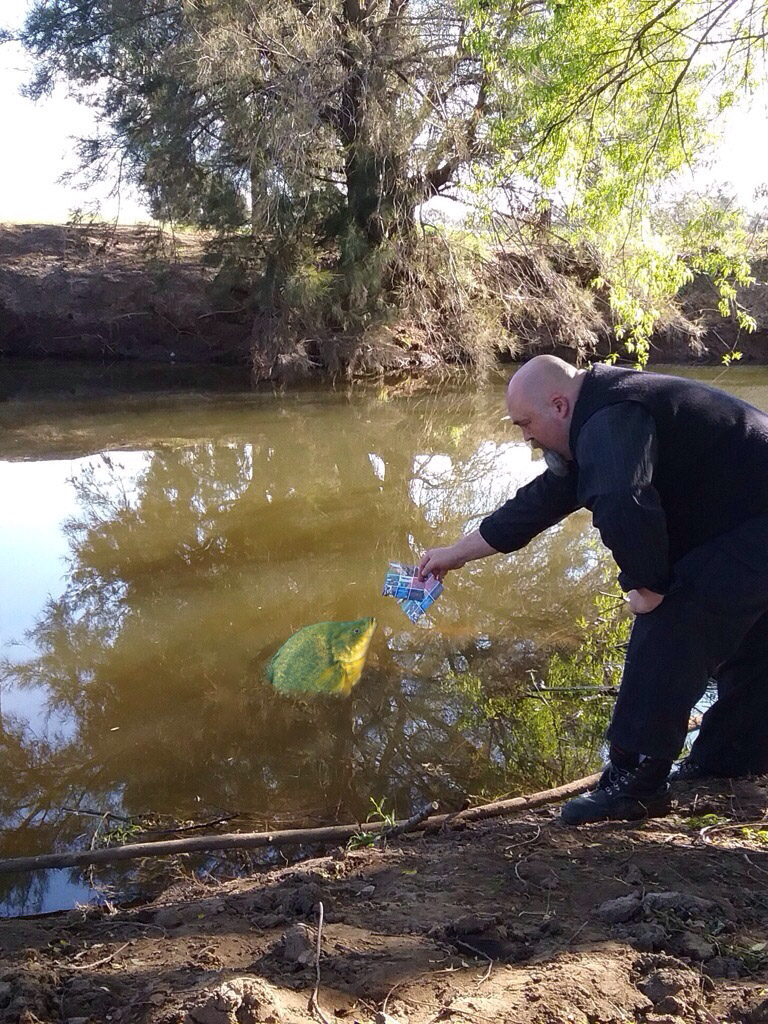
Warren: Great! By the way, these postcards came for you from some of the kids visiting the AoF Museum.

Augustus: For me? How strange, thank you very much.


Receiving the postcards
Receiving the postcards from Warren after the interview,
if I look surprised it's because I am!
The postcards were indeed for me, and the children who wrote them seem to be very intelligent, judging by the questions written in them, I will answer them in my next blog post.

In the meantime you may write in the comments what you thought of my interview and also what you would like Warren to ask me, when he interviews me in the near future.